

Dental amalgam fillings—often called silver fillings, mercury fillings, or metal fillings—have been used in dentistry for generations.At Natural Dentist Associates, we believe patients should understand what these restorations contain, how they may change over time, and the precautions that can be taken if they need to be removed.What Is a Dental Amalgam Filling?Dental amalgam is …

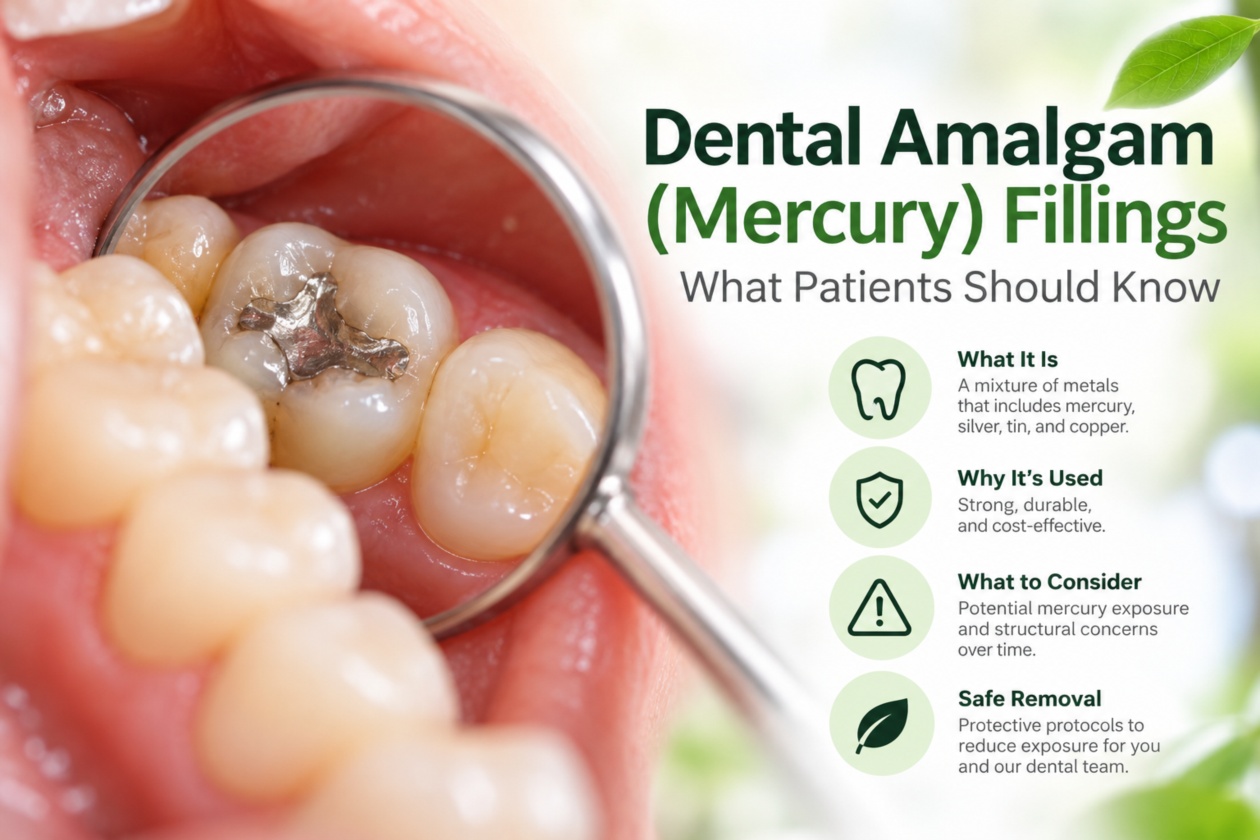
Dental amalgam fillings—often called silver fillings, mercury fillings, or metal fillings—have been used in dentistry for generations.
At Natural Dentist Associates, we believe patients should understand what these restorations contain, how they may change over time, and the precautions that can be taken if they need to be removed.
What Is a Dental Amalgam Filling?
Dental amalgam is a mixture of metals that traditionally includes:
- Mercury
- Silver
- Tin
- Copper
Mercury makes up approximately half of traditional dental amalgam by weight.
Amalgam became popular because it is:
- Strong and durable
- Relatively inexpensive
- Easier to place in areas where controlling moisture is difficult
- Less technique-sensitive than many tooth-colored restorative materials
These qualities made amalgam an important restorative material for many years.
Why Are Some Patients Concerned About Amalgam?
One of the primary concerns surrounding amalgam is its mercury content.
Dental amalgam restorations can release small amounts of mercury vapor. Because of this, the safety and appropriate use of amalgam have been debated within dentistry for many years.
The FDA currently identifies certain groups for whom it recommends avoiding new amalgam fillings when possible and appropriate. These include certain pregnant or nursing women, young children, and people with particular neurological, kidney, or mercury-sensitivity concerns.
The condition of the tooth, age and size of the restoration, presence of cracks or decay, the patient’s health history, and risks associated with removal should all be considered.
There Is Also a Structural Issue
Our concerns about older amalgam restorations are not limited to mercury.
Large amalgam fillings can place significant stress on the remaining tooth structure over many years.
Once an amalgam filling is more than 15 years old, we consider the possibility of decay underneath or around the restoration to be particularly important. In our clinical experience, the likelihood of finding recurrent decay beneath these older restorations can be very high—even when the tooth feels completely normal.
In our clinical experience, we frequently see older amalgam-restored teeth with:
- Decay underneath or around the restoration
- Cracks or fracture lines
- Deteriorating margins
- Loss of healthy tooth structure
- Large restorations that leave the remaining tooth vulnerable to fracture
One of the challenges is that these problems may be difficult for a patient to recognize. No pain does not necessarily mean there is no problem.
Metal restorations can also make it more difficult to see what is happening directly underneath them on routine dental X-rays. Sometimes the full extent of decay or cracking is not apparent until the old restoration is removed.
A tooth can therefore feel perfectly normal while changes are occurring underneath or around an older filling.
Why Can a Tooth Become Sensitive After an Old Filling Is Removed?
Patients sometimes ask:
“My tooth didn’t hurt before. Why is it sensitive now that the old filling is gone?”
Removing a large, older restoration can reveal cracks, decay, weakened tooth structure, or other problems that were already present but were not producing symptoms.
The new filling itself did not necessarily create the underlying problem.
This is one reason we evaluate each tooth individually and discuss the possibility that a tooth may ultimately require a larger restoration, such as a crown, depending on what we find.
Should Every Amalgam Filling Be Removed?
No.
We don’t believe treatment should be one-size-fits-all.
If you have amalgam fillings, the first step is an individual evaluation.
We consider:
- How old is the restoration—particularly, is it more than 15 years old?
- Is it large or small?
- Are there visible cracks?
- Are the margins breaking down?
- Is there evidence of decay?
- How much healthy tooth structure remains?
- Does the patient have symptoms?
- What are the patient’s health concerns and treatment preferences?
The goal is to make an informed decision—not to create fear.
If Amalgam Is Removed, How It Is Removed Matters
When we remove amalgam restorations, our goal is to reduce unnecessary exposure to mercury-containing particles and vapor for both the patient and our dental team.
At Natural Dentist Associates, we follow protective protocols based on recommendations from the International Academy of Oral Medicine and Toxicology (IAOMT) and its SMART approach to amalgam removal.
Depending upon the clinical situation, precautions may include:
- Isolation of the tooth with a dental dam
- High-volume suction
- Additional air filtration and evacuation
- Protective barriers for the patient
- Protective equipment for the dental team
- Techniques designed to minimize heating and aerosolization of the amalgam
- Careful containment and disposal of amalgam waste
These precautions are designed to reduce exposure during the removal process.
Protecting Our Team Matters Too
Dentists and dental team members may perform amalgam removal repeatedly throughout their careers.
That makes appropriate protection particularly important for the people working around these materials every day.
Our approach to safe amalgam removal developed not only from concern for our patients, but also from a desire to protect our doctors, assistants, hygienists, and the environment.
What Happens to Amalgam After It Is Removed?
Mercury-containing dental waste requires special handling.
Dental offices use amalgam separators and appropriate waste-management procedures to help prevent mercury-containing material from entering wastewater systems.
This environmental component is another reason we believe amalgam should be handled thoughtfully from the moment it is removed from a tooth through its final disposal.
Our Philosophy
We still practice dentistry.
We do fillings, crowns, implants, cleanings, orthodontics, and other traditional dental procedures.
What makes our approach different is that we also ask:
Can we accomplish the dental goal while reducing unnecessary exposures and supporting the patient’s overall health?
When an amalgam restoration needs treatment, we evaluate the entire tooth and discuss the available options with the patient.
Our goal isn’t to frighten people about what’s already in their mouths.
Our goal is education, careful evaluation, appropriate protection, and informed choice.
Have Older Silver Fillings?
If you have amalgam fillings that are 15 years old or older, or you simply don’t know how old they are, it may be a good time to have them evaluated.
We can examine each restoration individually for signs of deterioration, cracking, or recurrent decay and discuss whether monitoring or replacement makes the most sense for that tooth.
Natural Dentist Associates
Holistic Dentistry • Mercury-Safe Amalgam Removal • Metal-Free Restorative Options
This information is provided for educational purposes and is not intended to diagnose or treat any medical condition.
Book an Appointment
It’s easy and free!